By Gary Symons
TLL Editor in Chief
There are a number of sophisticated ways to use packaging to protect your brand from counterfeiters, but a Lithuanian tech company says the best solution is to engrave codes into the product itself.
LITILIT specializes in femtosecond laser technology, which can engrave codes into various products without damaging them due to heat transfer.
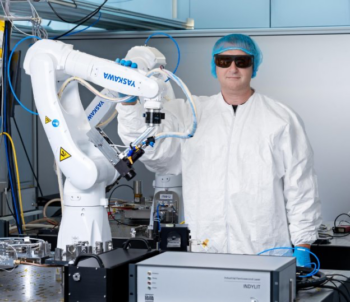
Labels and packaging are easy to copy and attach later, argues Nikolajus Gavrilinas (pictured above), co-founder and CEO of LITILIT. He says an alternative is using a femtosecond laser to engrave a code or serial number into the product itself. The code links to the product’s record, allowing brands, retailers, customs officials and shoppers to scan it to confirm authenticity.
“Femtosecond lasers mark materials with almost no heat transfer, letting them inscribe a permanent mark directly into a product or one of its components without damaging it,” Gavrilinas said. “Because the mark is written into the material itself, it can’t be peeled off or reapplied the way a printed label or sticker can, which makes the link between a product and its record far harder to fake.”
The Lithuanian laser manufacturer says engraving codes directly into products could help combat a growing flood of counterfeits, as counterfeiters increasingly ship fake labels and packaging separately to disguise where goods were made. Despite strong measures being taken by manufacturers and brand protection companies, customs seizures of counterfeits are still rising in Europe and the United States.
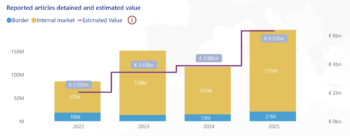
The rising tide of counterfeits is creating a high-stakes battlefield between counterfeiters, law enforcement, and global brands.
A recent report by the European Commission and the EU Intellectual Property Office found that EU authorities detained a record 196 million counterfeit items last year, worth an estimated 6.3 billion euros ($7.3 billion).
In the U.S., Customs and Border Protection seized 78.4 million counterfeit items in fiscal year 2025, and the value of seized fakes has more than doubled since 2021. Jewelry and watches have been among the most valuable categories for the past four years, according to the agency, which warns that counterfeit imports typically rise during the holiday season.
But LITILIT says femtosecond laser technology offers a solution for a wide variety of products. It says the marks can be placed on eyeglasses, sunglasses, jewelry, watches, diamonds, perfume and spirits bottles, smartphones, microelectronics and other goods made of metal, glass or plastic.
Femtosecond laser marking isn’t new; in fact, it’s a widely used system used in a variety of other industries. Medical device makers mark surgical instruments with codes that survive repeated sterilization, while carmakers mark parts for traceability. Femtosecond lasers are also used to cut smartphone screens, process glass for advanced chips, and perform eye surgery.
Gavrilinas said demand for the lasers is growing across multiple industries, but supply is struggling to keep pace because the lasers are complex to assemble and require highly qualified specialists.
LITILIT builds its lasers based on two international patents, one of which was developed with the Center for Physical Sciences and Technology in Lithuania. In October, the company opened a factory in Vilnius designed to produce up to 3,000 lasers a year at full capacity.
“We see demand coming from many directions at once, from brands fighting counterfeits to chipmakers and battery producers,” Gavrilinas said. “Every one of them needs precise, permanent marking or processing at industrial scale.
“The technology already works; the question is how many lasers can be built and installed on production lines fast enough to keep up,” he added.
LITILIT is based in Vilnius, but the company said it plans to replicate its production model in other regions with international partners to meet increased global demand.
You can learn more about LITILIT’s products HERE.