
By Gary Symons
TLL Editor in Chief
A ‘fast developing’ story this morning, as Polaroid says it has appointed IMG Licensing as its global licensing agency.
Polaroid is, of course, the instant photography brand that revolutionized photography, developing the first ‘instant photographs’ from a commercially available camera in 1948.
The company announced it has now appointed IMG Licensing as its exclusive global licensing representative in a multi-year agreement covering all consumer product categories and location-based entertainment.
IMG Licensing will manage the expansion of Polaroid’s global licensing program, developing products across fashion, home, technology, and lifestyle categories. The partnership aims to extend the brand’s presence while leveraging its distinctive assets, including its recognizable frame design, color spectrum, and iconic cameras.
“We’re super excited to be working with IMG Licensing and see our partnership as a fantastic way to energize the brand through exciting collaborations into new product categories and cultural spaces, ensuring every extension feels authentic to who we are while reaching new audiences and new generations,” said Dan Dossa, CEO of Polaroid.
The agreement positions Polaroid to expand its reach among Millennials and Gen Z consumers, demographics increasingly seeking tactile, real-world experiences beyond digital platforms.
Polaroid has a fascinating history, and despite the advent of digital photography and camera phones, it maintains a large niche fanbase of photographers who prefer the analog experience of the Polaroid cameras.
The Polaroid Corporation was founded by American scientist Edwin H. Land in 1937, but it wasn’t originally known as a leader of instant photography.
 In the beginning, Polaroid used polarizer technology (an optical filter) to create all sorts of unusual, fun products, including 3D movies and glare-reducing goggles for dogs.
Things got more serious during World War II, as the innovative company designed and manufactured many products for the armed services, including an infrared night viewing device and colored filters for rangefinders and periscopes.
But it was the development of instant photography that transformed Polaroid into a world-leading camera company.
It actually began near the end of the Second World War, when Land was on vacation with his family in 1944. His three-year-old daughter asked him why she couldn’t see the picture he had just taken of her on his camera, and in that second a flash bulb went off in the inventor’s mind.
Later the same day, Land said he came up with the camera design, the film, and chemistry that could accomplish his daughter’s wish.
However, it took another three years before a working model was built and presented to the public. The Polaroid Land Model 95 Instant Camera debuted in 1948 and capture the imagination of photographers all over the world. Over the ensuing decades Polaroid continuously improved the design.
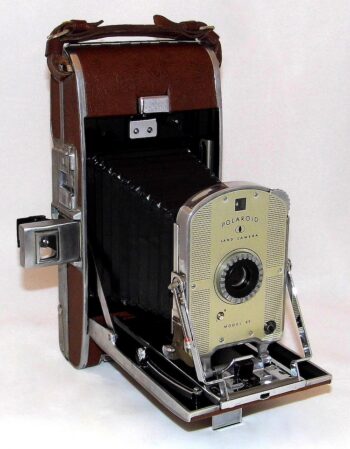
However, the advent of digital photography forced the company to cease production in 2008, and it appeared the days of the Polaroid were over.
Instead, the technology was reborn thanks to a group of instant photography fans who later that same year saved the last remaining Polaroid factory in the world, located in the Netherlands. It wasn’t easy, as they had to rediscover the chemical formulas and rebuild the factory equipment, but over time the team resurrected the classic Polaroid with a range of color and black & white film options.
Despite the obvious popularity and convenience of digital photography, Polaroid retains its hard-core fan base, and has produced several slick new camera options that hearken back to the company’s heydays from the 1940s to the 1980s.
Tim Smith, Senior Vice President at IMG Licensing, says the brand’s cultural significance goes beyond its product category, thanks to the camera’s ability to create a stronger connection to imagery.”
“Polaroid occupies a rare space in the cultural imagination — it is both a photography company and a symbol of human connection,” Smith said. “Its legacy is not simply about capturing images, but about shaping how generations experience memory, creativity, and immediacy.
“IMG intends to steward that legacy with rigor, purpose and imagination, identifying partnerships that honor Polaroid’s pioneering spirit while further extending its relevance in contemporary culture.”
Polaroid was supported in the transition to outsourced licensing management by Esther Jolley of Stobbs, a brand advisory firm.
It’s definitely worth taking a detour to the company’s website at www.polaroid.com to see how Polaroid has updated its new cameras for the next generation of photographers.