By Gary Symons
TLL Editor in Chief
Spam has been identified by its signature yellow and blue can for more than 90 years, but brand owner Hormel says it’s now time for the shelf stable pork product to enter new arenas.
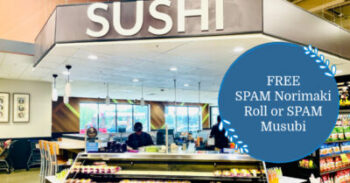
After the success of Spam musubi in Japan, Spam sushi and Spam Dog in the U.S., Hormel has realized there is literally an appetite for a wider menu of Spam-based food items.
That also opens up a wide variety of potential licensing opportunities, both through merchandise and food-based activations.
The unlikely food trend has been building for a while, thanks to innovations by a growing fan base of Spam lovers, particularly in Hawaii and the South Pacific, where Spam has become part of the popular culture.

Seeing their customers coming up with all kinds of recipes, Hormel realized it was time for Spam to bust out of the can and into recipes and deli counters.
It really started with Spam musubi, a popular snack popularized in Hawaii. It’s made with a slice of grilled Spam on top of, or sandwiched between, a block of rice, and then wrapped in nori. It’s been a staple in Hawaii for many years, a state with the highest per-capita Spam consumption in the nation at approximately 7 million cans annually.
In 2021, Hormel worked with Family Mart stores in Japan to introduce Spam musubi in that country, which quickly became a viral food trend. What started as a limited-time offer turned into a popular treat across the country that’s now available in 16,000 stores. This past year the Spam musubi hit a major milestone, selling more than 100 million units in FamilyMart locations.
Thanks to that success, Hormel began to look at more opportunities across a broader horizon.
 For example, in 2025 Hormel launched Spam sushi, and this year Hormel launched the Spam Dog, a hot dog wiener made of Spam. The company is pushing Spam into new culinary territory — sushi counters, convenience store hot dogs and beyond — as part of a broader strategy to expand the canned meat’s presence across more eating occasions and consumer demographics.
“We continue to innovate inside the can, but we’re really trying to think about how can we get outside of it,” said Kelsey Hannon, a brand manager for Spam at Hormel. “We do see a huge opportunity.”
Hannon and two other brand managers were hired by Hormel to help guide Spam’s expansion into new food categories, and the plan seems to be working. The brand has posted record sales in nine of the past 10 years, according to Hormel’s sales data.
Part of that is making Spam products available on more shelves in the supermarket. For example, Hormel partnered with Kroger in 2025 on its Spam sushi, and Albertson’s has subsequently put out its own version.

“We are thinking about things like that because convenience is a trend, and it’s not going anywhere,” Hannon said.
Hannon notes that when consumers try things like Spam sushi at the deli counter, they’re also more likely to buy cans of Spam to make similar things at home.
The Spam Dogs were introduced in February this year through the Rutter’s convenience store chain in the northeastern United States. The product took off, and since then it has also been offered at sports stadiums and other retail venues.
Hannon said a change in Hormel’s executive ranks has helped create fresh appetite for growth, and a willingness to innovate in product development, licensing partnerships, and expanding its social media game by connecting with consumers who are already experimenting with the product on their own — deep-frying it, pairing it with eggs or incorporating it into other dishes.
“We’ve gotten all new leadership, and they truly see the potential of this brand,” she said. “We say it was born in America, but it was raised around the world. And we have consumers that have such authentic connections to the brand that we need to figure out how to tap into that.”
In short, the company is suddenly keen to look at smart partnerships for a brand that is suddenly showing a lot of potential.
“There is potential for extreme growth,” Hannon said.